
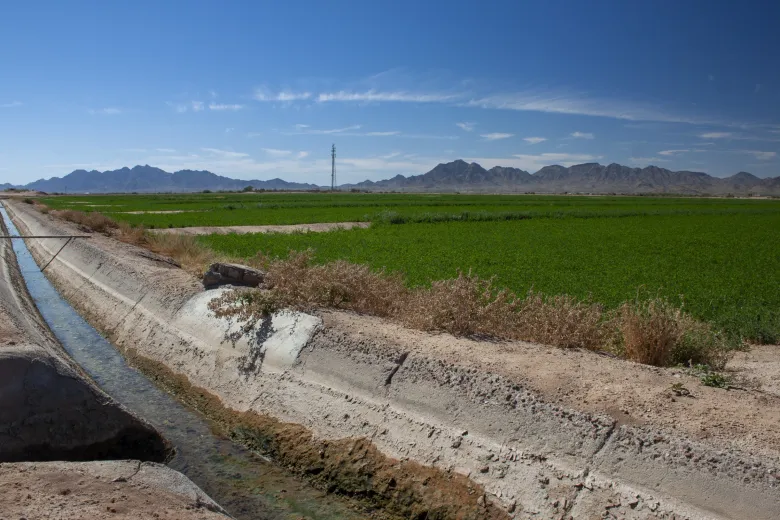
The Rising Importance of Brackish Water Desalination in the American West’s Agriculture
The American West, facing what is described as its driest drought in over 1,200 years, is grappling with a severe water crisis that puts its vital agricultural production and national food security at risk. Traditional freshwater sources, including rivers and aquifers, are over-tapped, leading to a critical need for alternative water supplies . In this challenging landscape, the desalination of brackish groundwater is emerging as a critical, climate-resilient solution for the agricultural sector.
The Water Challenge in the West
Agriculture is the economic foundation for many western communities and currently consumes 70-80% of the available water in the Western United States. This reliance on a shrinking water supply is unsustainable. The over-pumping of freshwater has led to seawater intrusion in coastal areas and the depletion of inland aquifers, resulting in water that is too salty for irrigation without treatment. Groundwater with total dissolved solids (TDS) above 3,000 mg/L can make land infertile and is generally unsuitable for most crops or livestock.
The Role of Brackish Water Desalination
Desalination offers a way to tap into the vast, otherwise unusable, brackish groundwater reserves found throughout the U.S., which a U.S. Geological Survey report estimates could satisfy nearly 800 years of use at current rates. This process involves removing salts and minerals, typically through reverse osmosis membrane filtration, to create freshwater suitable for crops.
Key benefits for agriculture include:
- Drought Resilience: Desalination provides a stable, drought-resistant water source independent of rainfall.
- Economic Viability: While the cost of desalinated water is currently higher than traditional sources, it can be profitable when used for high-value crops, such as fruits, vegetables, and nuts, especially within controlled environments like greenhouses.
- Improved Yields: Assured, high-quality irrigation water can increase crop productivity and consistency, raising net profits.
- National Security: Moving from import-dominated to an export-supported agricultural base, which can be aided by secure water sources, is vital for national food security.
Innovations and Challenges
Technological advancements are addressing previous concerns about cost and energy use. New prototype systems using electrodialysis, for example, are proving to be more energy-efficient and offer a higher recovery of freshwater than traditional methods.
However, challenges remain, primarily the management of the concentrated salt (brine) waste product, especially for inland plants where disposal options like deep-well injection are needed. Researchers are actively exploring cost-effective and environmentally sound disposal methods.
Brackish water desalination is not a single “magic cure” but a crucial tool in a diversified water management portfolio that also includes significant water conservation and efficiency measures.

Hi, this is a comment.
To get started with moderating, editing, and deleting comments, please visit the Comments screen in the dashboard.
Commenter avatars come from Gravatar.