
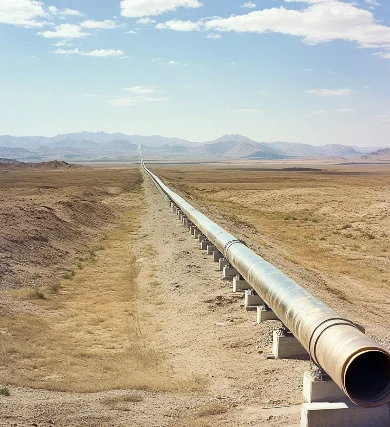
Low Friction Hyper Aquifer (LFHA)
For more than 2,000 years, water managers have relied on aquifers and pipelines to transport water to desired locations.
The concept of pipelines for transporting fluids, including water, dates back to prehistoric times, with the earliest known examples used primarily for water transport:
- Around 5000–3000 BC, ancient civilizations in Mesopotamia (modern-day Iraq), Egypt, and the Indus Valley employed clay, stone, or terracotta pipes to convey water for irrigation, drinking, and sanitation. These early systems were gravity-fed and part of basic aqueducts or drainage networks. Copper pipes were also used in ancient Egypt around 3000 BC for similar purposes. 1
- By 2500–500 BC, the ancient Chinese developed bamboo pipelines to transport natural gas from seeps for lighting and heating, as well as brine (saltwater) for salt production. One notable example is a 40 km (25 mi) pipeline made from hollowed tree trunks in Hallstatt, Austria (though dated to around 1595, it reflects earlier brine transport techniques). These were among the first pipelines for gaseous or saline fluids. 3
- In the Classical period (around 500 BC–AD 500), the Greeks and Romans advanced pipeline technology significantly. The Romans built extensive aqueduct systems incorporating lead, clay, or stone pipes to distribute water across cities like Rome. These networks spanned hundreds of kilometers and relied mostly on gravity, but included innovations like inverted siphons for crossing valleys. A famous example is the Roman aqueducts, which supplied water to public fountains, baths, and homes. 1,3
These early pipelines were short-range and material-limited (e.g., prone to leaks or breakage), but they laid the foundation for fluid transportation. Over the centuries, humanity has improved pipelines and aqueducts through incremental advancements, such as better materials and the addition of pumps to push water uphill.
- Around 270 BC, Greek engineer Ctesibius invented the force pump (a piston-based device), which could push water up through an outlet pipe by reciprocating motion. It was used in Hellenistic Alexandria for firefighting, fountains, and small-scale water supply, elevating water short distances (e.g., into discharge tubes). Romans adopted it widely (~1st century BC–AD), with surviving bronze examples showing its use to lift water in mines, ships, or urban systems. 2,4
- In ~287–212 BC, Archimedes developed the screw pump, a helical device rotated to lift water into pipes or channels. It was used for irrigation and drainage. 5
- By ~189 AD, ancient Chinese used chain pumps (endless chains with buckets or pallets) to elevate water into stoneware pipe networks for palaces and cities, integrating pumps directly with pipelines for distribution over elevation changes. These were human- or animal-powered. 2
In short, for thousands of years, we have used essentially the same technology with only small incremental improvements. Today, modern society depends heavily on pipelines to transport water over long distances—pipelines that are expensive to build and maintain. While modern pumps, materials, and designs have extended service life and improved efficiency, these remain incremental advances, and still fall short of the need in large scale water transportation. Mainly for this reason, the United States lacks a national water grid or comprehensive system to move abundant water to areas of need. Our forebears built remarkable dams and river management systems, particularly in the Western U.S., providing water to nearby regions through some of the greatest engineering feats in history. Most of the activities on the Colorado River, where invested over a 5 to 6 decade period, with the intension to provide a reliable ample water supply to communities and farms in the Colorado River Basin. Unfortunately, it has been more than 5 decades since our last major project was completed. Smaller projects have been continuing but nothing to secure the future of the Colorado River Basin and to keep up with the sustained growth the Basin has experienced. Furthermore, in the west as a whole, we have failed to move forward making any big leap forward with pipeline technologies. The lack of needed technology has resulted in the US having water distribution issues that continues to grow, and with the gap between water needs and ability to provide broadening every day. This is an issue that begs the question why?
Today we discharge vast amounts of freshwater into the ocean along both coasts of the continental United States and North America. For example, the Mississippi River discharges roughly 435 million acre-feet into the Gulf of Mexico each year7—water that is effectively “wasted” after all basin allocations have been met. USGS estimates show that the United States uses approximately 314 million acre-feet of freshwater annually (including agricultural use). The Mississippi alone could undoubtedly supply the nation’s entire freshwater needs based on these figures. The challenge lies in distribution, environmental impacts on the river system, legal considerations, and numerous other issues, with lack of needed technology as the biggest road block. The Mississippi is not the only major river discharging to the ocean; the Columbia River contributes roughly 192–200 million acre-feet per year. And the rivers wasting fresh water into the oceans are numerous. We would be amiss if we did not recognize the use of these rivers as water ways for cargo transportation, and that the water flowing into the oceans is needed to support those transportation needs. However, even just a small fraction of the water from these water ways could have huge lasting impacts on the Western US Water systems and support the continued growth the west is experiencing without having an impact to river to ocean transportation needs. If one was to calculate the sum major U.S. rivers, total annual freshwater discharge to the ocean, calculated averages would easily exceed 1.51 billion acre-feet7 on average. Thus, U.S. water production far exceeds demand—so honestly it is not a supply problem, it is primarily a distribution problem and even a technology problem. While solutions must address water rights, environmental effects, and other factors, the absence of an efficient, large-scale distribution mechanism prevents water from reaching areas with the greatest need and potentials.
This is where the Low Friction Hyper Aquifer (LFHA, patent pending) plays a transformative role. Traditional pipelines face two major challenges, even with modern advancements:
- Friction (head loss): Friction causes pipe wear (erosion and corrosion) and requires significant energy to maintain flow. Friction energy wasted in a pipeline increases as a factor of the square of velocity, so higher speeds demand exponentially more energy and cause greater pipeline pressure drops over shorter distances, necessitating more frequent pumps. Furthermore high fluid velocities cause more turbulence and increase erosion and wear on pipes. As a result, conventional systems move water slowly (typically 4–5 mph) to avoid these issues or at least minimize them. And capacity is typically increased by adding pipes or enlarging diameters of the pipes.
- Elevation changes: Pumping water uphill consumes enormous amounts of energy due to gravitational potential energy— which makes sense why so much power is needed given it is the inverse of hydroelectric power generation.
These issues have long blocked large-scale national water transport systems. Or the using of pipes to move substantial (game changing) amounts of water. So how do we remove these roadblocks is the natural next question.
Water for the West has developed LFHA, a technology that virtually eliminates friction in pipelines. While Water for the West has not found a solution to eliminate or reduce gravity (thus eliminating potential energy costs), the elimination of friction does yield four key benefits:
- Dramatically increased transport speed and volume: With LFHA and the virtual elimination of friction, flows can increase anywhere from 10 to 100 fold that of a traditional pipeline of the same diameter. This enables vastly higher throughput without larger infrastructures. A typical 4 ft diameter non-LFHA pipe system might deliver around 84,000 acre-feet per year (depending on operating parameters). In contrast, a LFHA 4ft diameter system could easily deliver 7.5 Million acre-feet per year. The following are some examples of year flows using LFHA technology:
- Two 4-foot pipes to transport ~7.5 million acre-feet per year.
- Two 6-foot pipes to transport ~13 million acre-feet per year.
- Two 12-foot pipes to transport ~35 million acre-feet per year.
Volumes like these change the game as far as water transportation capabilities. These volumes position LFHA to be used as a backbone of a national-scale water distribution network.
- Reduced maintenance: With near-zero friction, pipe erosion and wear are minimized, lowering long-term costs and enabling sustainable, low-maintenance operation.
- Broader applications: LFHA could redirect excess water from rivers like the Mississippi, Columbia, or St. Lawrence (currently discharged to the ocean) to arid regions. It could also capture floodwaters for use storage, reducing flood risk while increasing water reserves.
- LFHA does have one advantage over traditional pipes with regards to gravity, in that because of the technologies frictionless capability, the Potential Energy needed to move water is no longer based on gross elevation gains, but strictly on net elevation gains from end to end of the transport system. This matters because transportation corridors no longer need to be flat to minimize energy costs. But the easiest to implement transportation corridor can be chosen verse choosing paths that minimize elevation changes. This can greatly reduce implementation costs, and avoid environmental, regulatory, or territorial issues with building a pipeline corridor from end to end.
These benefits are huge from a cost and feasibility perspective, and this technology is a game-changer for addressing U.S. water distribution challenges. Water for the West is committed to refining LFHA, advancing it to demonstration, and deploying it in the Western United States. Our vision is to transform the West from a region where water is managed for survival to one where it enables thriving.
Potential benefits include:
- Expanded agriculture in western deserts with ample water supply.
- Relief for the over-allocated Colorado River system (LFHA could hypothetically double its effective flow, pending system capacity studies).
- Reduced flooding and enhanced aquifer storage across the wester US.
- Support for continued population and economic growth in water-stressed areas.
Implementing LFHA on a large scale will require approvals, environmental reviews, and collaboration—but at this point in our nation’s history, innovative new technologies are essential to solve modern water challenges. Water for the West is optimistic about LFHA’s potential to provide abundant water across the United States, reduce flooding, unlock desert lands for productive use, and secure water as a resource for thriving.
If you would like to learn more about LFHA or discuss collaboration, please reach out—we would be glad to provide further details and look forward to partnering with the U.S. government, states, and stakeholders to bring this solution forward.
Backup Data: Typical Average River Flows into the Oceans in the United States6,7
| River | Outlet | Average Discharge (cfs) | Estimated Annual Volume (acre-feet/year) |
|---|---|---|---|
| St. Lawrence River (transboundary) | Gulf of Saint Lawrence (Atlantic Ocean) | 348,000 | ~252 million |
| Yukon River | Bering Sea | 227,000 | ~164 million |
| Atchafalaya River (distributary of the Mississippi) | Gulf of Mexico | 225,000 | ~163 million |
| Mobile River | Gulf of Mexico | 67,000 | ~49 million |
| Kuskokwim River | Bering Sea | 67,000 | ~49 million |
| Copper River | Gulf of Alaska (Pacific Ocean) | 57,400 | ~42 million |
| Stikine River (transboundary) | Pacific Ocean | 56,000 | ~41 million |
| Susitna River | Gulf of Alaska (Pacific Ocean) | 51,000 | ~37 million |
| Saint John River (transboundary) | Bay of Fundy (Atlantic Ocean) | 38,800 | ~28 million |
| Susquehanna River | Chesapeake Bay (Atlantic Ocean) | 38,200 | ~28 million |
| Nushagak River | Bering Sea | 32,000 | ~23 million |
| Alsek River (transboundary) | Gulf of Alaska (Pacific Ocean) | 31,000 | ~22 million |
| Sacramento River | Pacific Ocean (via San Francisco Bay) | 23,500 | ~17 million |
| Colorado River | Gulf of California (Pacific Ocean) | 22,000 | ~16 million (historical; often ~0 currently) |
| Hudson River | Atlantic Ocean | 21,900 | ~16 million |
| Apalachicola River | Gulf of Mexico | 19,602 | ~14 million |
| Connecticut River | Atlantic Ocean | 18,400 | ~13 million |
| Kvichak River | Bering Sea | 17,900 | ~13 million |
| Klamath River | Pacific Ocean | 17,300 | ~13 million |
| Santee River | Atlantic Ocean | 17,000 | ~12 million |
| Skagit River | Pacific Ocean (via Puget Sound) | 16,500 | ~12 million |
